

English
Platform settings
This is where the thresholds, deadlines and switches that shape how WAYDOT behaves are tuned: when a ticket is assigned on its own, what counts as an arrival, how much a clock-in tolerates, what happens to a rooted phone, how long the audit log is kept…
Where it is: Configuration → Platform settings. Who sees it: people allowed to read settings; changing them needs manage settings. Without it: You can read these settings; changing them needs the settings:manage permission.
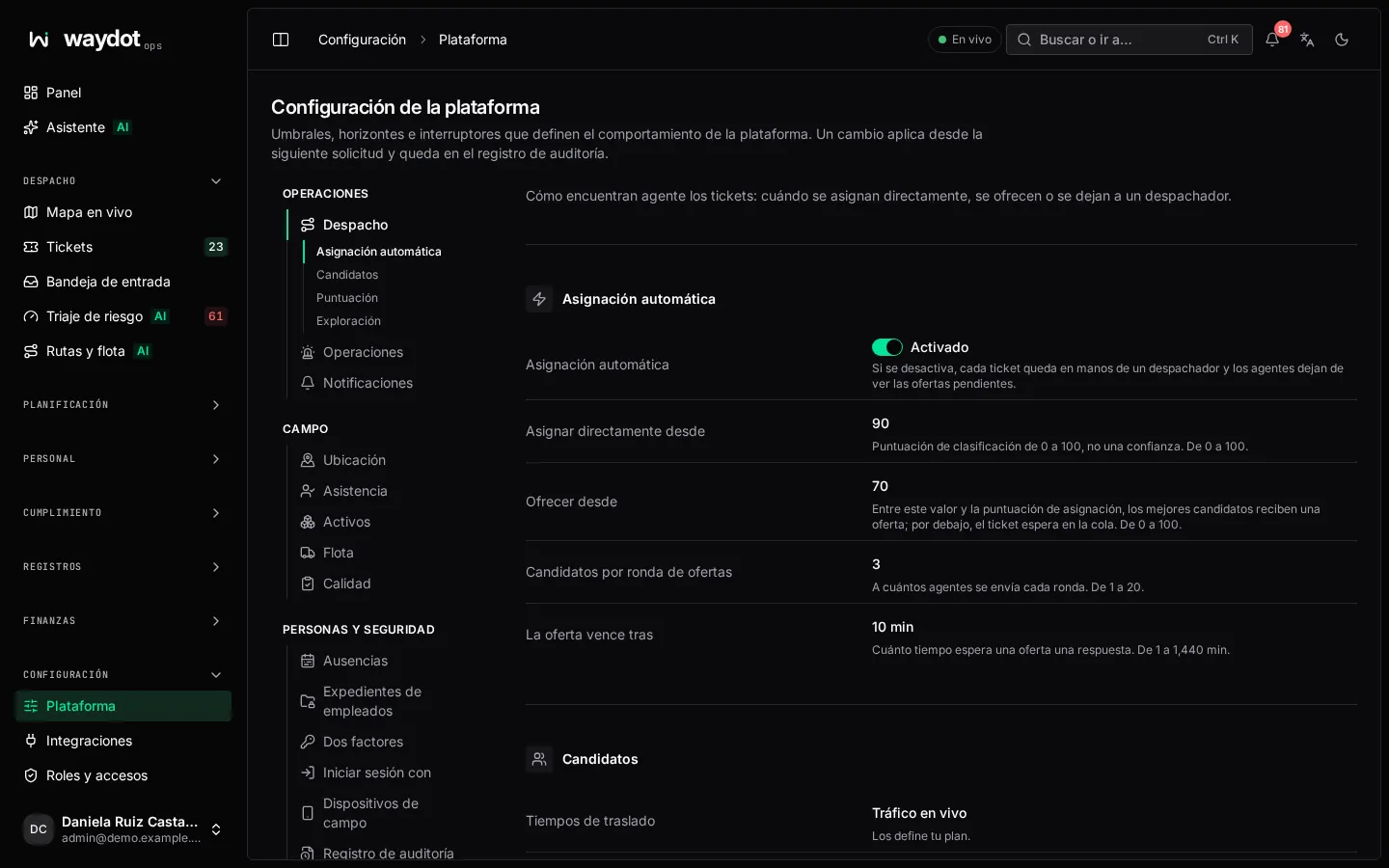
How it works
- On the left, the groups, arranged under Operations, Field, People & security, Finance and Platform. Each group has a summary and its sections.
- Each value is changed where it's read and saved on its own. The allowed bounds are explained in the hint and checked before sending.
- A change applies on the next request and is recorded in the audit log (who, when, old and new value).
- Some groups have a master switch (for example Automatic assignment or Randomized audits); off, the group shows … is switched off and its other values don't apply.
- Groups for modules your plan doesn't include don't appear.
The tables below list each setting with its default in a new workspace.
Operations
Dispatch
How tickets find an agent: when they're assigned outright, offered, or left for a dispatcher. See Assign a ticket.
| Setting | What it does | Default |
|---|---|---|
| Automatic assignment | Master switch. Off leaves every ticket for a dispatcher and hides pending offers from agents. | On |
| Assign outright at | Ranking score (0 to 100, not a confidence) from which the top candidate gets the ticket without being asked. | 90 |
| Offer at | Between this and the score above, the top candidates get an offer; below it, the ticket waits in the queue. | 70 |
| Candidates per offer round | How many agents one round is sent to. | 3 |
| Offer expires after | How long an offer waits for an answer before the next round. | 10 min |
| Longest useful travel time | A trip this long scores zero on proximity; longer ones rank last. | 90 min |
| Oldest usable position | Agents whose last fix is older are left out rather than ranked on a stale position. | 15 min |
| Assumed travel speed | Turns straight-line distance into minutes when no routing or traffic is used. | 30 km/h |
| Score weights | How much each factor counts, as shares of 100%: Proximity, Workload, Shift fit, Skills. Used until a dispatch regime has weights of its own. | 40 / 25 / 20 / 15% |
| Exploration | Occasionally picks a near-top candidate so new weights can be measured. Costs a little dispatch quality now. | Off |
| Exploration temperature | Lower stays closer to the top score. | 0.1 |
| Travel times | Read-only: set by your plan. Straight line at the assumed speed (Basic), Road routing, typical traffic (Pro) or Live traffic (Enterprise). | By plan |
Operations
Escalation, follow-up visits, scheduled visits and multi-agent teams.
| Setting | What it does | Default |
|---|---|---|
| Automatic escalation | Off stops escalations advancing; chains stay configured and history readable. | On |
| Follow-ups before sign-off | Visits one job may take before the next needs sign-off from somebody who can dispatch. | 3 |
| Scheduled visit tickets | Off stops visit plans raising tickets; tickets already raised stay live. | On |
| Default time zone | For a visit plan that names none. | America/Tijuana |
| Default lead time | How many days ahead of a visit its ticket is raised when the plan says nothing. | 3 days |
| Supporting agents per ticket | The most agents staffed beside the assignee. | 5 |
| Co-presence window | How far apart team members may arrive and still count as having worked together. | 30 min |
Notifications
When notifications fire and how many reach each person. See Notification rules.
| Setting | What it does | Default |
|---|---|---|
| Notification delivery | Off evaluates no rule and delivers nothing; triggers still fire. | On |
| Per person, per hour | Cap across every rule. A rule may be stricter, never looser; emergencies are exempt. | 20 |
| Unassigned ticket alert | How long a ticket may go unclaimed before it's announced. | 10 min |
| SLA warnings | Minutes before the deadline; the trigger fires as each is crossed. | 60, 30 and 15 |
| Rule preview history | Days of past events used to estimate how often a rule would fire. | 30 days |
Field
Location
Background tracking, geofences, arrivals and the checks that catch impossible travel. See GPS integrity.
| Setting | What it does | Default |
|---|---|---|
| Background tracking | Master switch. Off stops the trail, fences and anomaly checks; the last-known position dispatch uses is kept. | On |
| Least accurate usable fix | Less accurate readings are stored but never open a visit or raise a finding. | 50 m |
| Keep breadcrumbs for | Only the raw trail is pruned; visits and anomalies are kept. | 2,557 days (7 years) |
| Default fence radius | For a fence drawn without one. A warehouse yard usually wants more. | 50 m |
| Arrival radius | An agent this close to the site, moving slowly enough, has arrived. | 50 m |
| Arrival speed limit | Faster is a drive-by, not an arrival. | 15 km/h |
| Impossible travel | One segment this fast raises a finding. | 1,000 km/h |
| Excessive speed | Above road speeds. Not a speeding alert. | 160 km/h |
| Excessive segments in a row | How many in a row must exceed it before a finding; a GPS glitch doesn't hold it that long. | 3 |
| Shortest measured segment | Shorter segments are skipped rather than turning jitter into speed. | 5 s |
Attendance
Clocking in and out, and how the daily sweep reads a shift that went unrecorded. See Attendance.
| Setting | What it does | Default |
|---|---|---|
| Attendance | Master switch. Off refuses clock events and pauses reconciliation. Rosters aren't affected. | On |
| Require a position | Turn off only for back offices without smartphones. A clock-in away from every authorized area is always accepted, marked unverified and reported. | On |
| Clock-in radius | How near an authorized area a clock-in counts as verified. | 50 m |
| Least accurate clock-in | A less accurate clock-in is refused outright. | 50 m |
| Default grace period | What a new shift definition starts with; each shift keeps its own. | 15 min |
| Early clock-in window | How early a clock-in still counts as the rostered shift. | 120 min |
| Overtime after | Past the rostered length. Only flagged, for manual sign-off. | 30 min |
| Absent after | Minutes past grace with no clock-in before it's marked absent. | 60 min |
| Close open shifts after | How long past the shift's end an open record waits before closing as incomplete. | 240 min |
| Longest roster generation | Guards against a mistyped year generating years of shifts. | 180 days |
| Longest rotation cycle | The longest cycle a shift pattern may define. | 90 days |
| Break start tolerance | How far either side of the planned slot a break may start. | 10 min |
| Plan breaks ahead | How long before the shift its breaks are planned, to weigh the day's workload. | 60 min |
Assets
Proof of custody for field moves, agent-to-agent handovers and lifecycle. See Asset transfers.
| Setting | What it does | Default |
|---|---|---|
| Require a position for field moves | Asset administrators are exempt: a desk correction has no field position. | On |
| Custody proof radius | How close a field move must be to the transfer's place. A loading bay isn't the map pin. | 250 m |
| Handover distance | Both agents must be this close when units are offered and accepted. | 50 m |
| Handover offer expires after | 15 min | |
| Nearby search radius | How far "who nearby has this part" reaches. | 10,000 m |
| Oldest usable position | How old the other agent's last fix may be. | 10 min |
| Warranty warning | Days before expiry a unit's cover counts as expiring. | 30 days |
| Deprecate once depreciated | An active asset may only be phased out past this share of its cost. | 80% |
| Replacement flag | Share of value lost before a unit is flagged for replacement planning. | 90% |
Fleet
When papers and service count as coming due, which fill-ups are flagged and who may be handed a vehicle. See Vehicles.
| Setting | What it does | Default |
|---|---|---|
| Paper expiry warning | Days before a policy or emissions check lapses that the vehicle counts as expiring. | 30 days |
| Require a driver licence | Off, a missing licence is tolerated; a lapsed one always refuses the handover. | Off |
| Service reminder by date | Days ahead of a plan's due date that it counts as due soon. | 14 days |
| Service reminder by distance | km ahead of the due odometer. | 500 km |
| Flag fill-ups from | A fill-up of this amount or more is flagged for manual audit. | $1,500.00 |
| Longest mileage report | How many days one odometer-against-GPS report may cover. | 2,557 days |
Quality
Randomized audits, defect deadlines and checks on photographic evidence. See Quality rules.
| Setting | What it does | Default |
|---|---|---|
| Randomized audits | Master switch. Off stops sampling; rules, open audits and defects are untouched. | On |
| Audit ticket SLA | Its own deadline, so an audit never lands in the client's breach report. | 72 h |
| Critical / Major / Minor defects | Hours to put it right; stamped when the defect is raised. | 24 / 72 / 240 h |
| Evidence distance from site | A rooftop or street cabinet is legitimately photographed a way from the address. | 250 m |
| Device clock tolerance | How far ahead of the server a capture time may be before it's treated as spoofed. | 120 s |
People & security
Employee files
| Setting | What it does | Default |
|---|---|---|
| Driver licence warnings | Days before expiry; a warning goes out at each. | 60, 30 and 15 |
| Certificate warnings | When DC-3 certificates and medical evaluations start to warn. | 30 days |
| Proof of address valid for | An older one no longer proves a current address. | 90 days |
| Home fence radius | The fence drawn around an employee's home address. | 100 m |
Leave
How leave is counted and what vacation is owed, over the floors of the Ley Federal del Trabajo. See Leave.
| Setting | What it does | Default |
|---|---|---|
| Working days | Leave is counted over these days only; Art. 69 guarantees one rest day per six worked. | Monday to Saturday |
| Refuse vacation beyond the balance | Only for people whose hire date is on file. | On |
| Vacation premium | Paid on top of the wage for vacation days; Art. 80 sets 25% as the floor. | 25% |
| Grant within | Months after an anniversary to grant its days; Art. 81 allows six. | 6 months |
| Days lapse after | Months after an anniversary that unused days lapse (the six to grant them plus the year Art. 516 allows to claim them). | 18 months |
Two-factor
| Setting | What it does | Default |
|---|---|---|
| Two-factor authentication | Off stops asking for a code but keeps every enrollment; turning it back on restores them. | On |
| Expected for roles | These people are prompted to enroll. It isn't enforced at sign-in, so nobody is locked out. | Super administrator and HR administrator |
Sign in with
| Setting | What it does | Default |
|---|---|---|
| Accepted providers | Google and/or Microsoft. Each person connects their account from their security settings. Single sign-on, when it covers an address, still wins. | Both |
| Google Workspace domains | Only accounts from these domains, comma separated. Empty: any Google account, Gmail included. | Empty |
| Microsoft tenant IDs | Only accounts from these Entra ID tenants. Empty: any Microsoft account, personal ones included. | Empty |
Field devices
What happens to a phone that fails its integrity check. See Field devices. Each one takes Warn and carry on, Read-only or Block.
| Setting | What it detects | Default |
|---|---|---|
| Rooted phone | An unlocked system, so its reports can be altered. | Warn |
| Emulator | The app on a computer pretending to be a phone. | Warn |
| Mock location enabled | Every position it sends is already raised as an anomaly. | Warn |
| Modified app | A build other than the one your organization distributes. | Read-only |
| Keep health reports for | The session keeps the latest finding and the audit log every change. | 90 days |
Audit log
| Setting | What it does | Default |
|---|---|---|
| Audit log screen | Hides the read surface only; events are always recorded. | On |
| Searchable for | Days before events are archived. | 365 days |
| Kept for | In total, archive included. The compliance policy asks for seven years. | 2,555 days |
Your plan limits how many days can be searched (90 on Basic, 365 on Pro, 2,555 on Enterprise).
Finance
Finance
| Setting | What it does | Default |
|---|---|---|
| Currency | ISO code claims are made and paid in. | MXN |
| Days on hold | A claim still waiting for its receipt or for a duplicate to be cleared is rejected after this many days. | 14 days |
| Stop length | Staying put this long splits the GPS trail into two trips. | 5 min |
| Stop radius | How far a stop's readings may wander; a trip must get this far to count. | 100 m |
| Labour on-cost | What an hour costs beyond the integrated wage: employer contributions, payroll tax and benefits. | 35% |
| Overhead | The share of indirect cost each ticket carries, as a % of its labour, travel, parts and expenses. | 15% |
Funding
How people in the field pay for fuel and expenses and how each period is reconciled. See Funding.
| Setting | What it does | Default |
|---|---|---|
| Funding | Reimbursement, Card with an allowance or Advances. The default for everyone; each person can have another. | Reimbursement |
| Allowance per period | What somebody on a card allowance may spend in one period. | $3,000.00 |
| Limits | Compare at reconciliation accepts spending past the allowance or advance and shows it at settlement; Strict refuses it when logged. | Compare |
| Period | Monthly, Twice a month (1–15 and 16–end) or Every set number of days from 1 January. | Monthly |
| Days per period | Only when the period is a number of days. | 15 |
| Days to justify | After a period ends, days before its settlement counts as overdue. | 5 |
| Money left from an advance | What's suggested: Returned by deposit, Carried into the next period or Deducted from payroll. | Returned |
| Bank fee on a return | Who bears it: The person or The company. | The person |
| Spent beyond an advance | Reimbursed, Reimbursed up to the cap or Not reimbursed. | Reimbursed |
| Reimbursement cap | The most a capped reimbursement pays back in one period. | $500.00 |
| Spent beyond a card allowance | Returned by deposit, Deducted from payroll or Forgiven. | Deducted |
| One advance at a time | A new one waits until the earlier one is deposited, turned down or withdrawn. | On |
Payroll
The tax tables payroll withholds by, the employer rates only your organization knows and the year-end bonus. Needs the Payroll add-on.
| Setting | What it does | Default |
|---|---|---|
| Tax tables | ISR, subsidy, UMA, minimum wage and IMSS rates, one version per publication. See Tax tables. | The current published ones |
| Minimum wage zone | General or Zona Libre de la Frontera Norte. Earning no more than the zone's minimum exempts a worker from ISR and the employer pays their IMSS share. | General |
| Work risk premium | Your organization's own, from its yearly determination with IMSS. | 0.54355% |
| State payroll tax | The ISN rate where payroll is paid. Reported as an employer cost; never withheld. | 3% |
| IMSS employer registration | The 11 characters with check digit (e.g. Y5412345108). Every IDSE and SUA file starts with it. | Empty |
| Subdelegation guide | The five digits IDSE asks for on each notice. | Empty |
| Year-end bonus | Days of wage paid as aguinaldo. The law sets fifteen as the floor. | 15 days |
Platform
Intelligence
Policy gates, costs and approvals the model projections are held to. Needs the Intelligence module.
| Setting | What it does | Default |
|---|---|---|
| Minimum slack | Slack a plan must keep against every deadline, or it isn't proposed. | 0 min |
| Largest breach risk increase | Between 0 and 1: the most a plan may raise any ticket's breach risk. | 0.05 |
| Protect jobs past | Share of progress (0 to 1) past which a job in flight isn't pre-empted. | 0.2 |
| Client acknowledges moved appointments | A plan that moves an appointment needs the client's OK. | On |
| Exclude fatigued agents | Agents over the rest or shift limits are left out of plans. | Off |
| Escalation owner | Who a refused or escalated plan is handed to. | Dispatcher |
| Cost per reassignment | Charged to a plan for each reassignment it causes. | 10 |
| Cost per travel minute | Charged to a plan per minute of travel. | 1 |
| Minimum dwell | A fence crossing counts as presence after this long. | 3 min |
| Least accurate indoor fix | Beyond this a fix can't place an agent inside rather than near. | 50 m |
| Minimum rest between shifts | Contractual; a limit, not a model output. | 12 h |
| Longest shift | Contractual maximum. | 9 h |
| Incidents to call a hotspot | Rates are per active asset-hour, so a busy area isn't mistaken for a large one. | 5 |
| Hotspot history | Days spatial analytics may use. | 90 days |
| Fleet fuel use | Litres per km. Empty until real figures exist; routes then report distance only. | Empty |
| Tailpipe CO₂ | kg per litre. Never used for an offset claim. | Empty |
| Aggregate attrition planning | Withheld until approved. Individual scores are never produced. | Off |
AI
Whose key AI runs on, what it may spend each month and whether it reads the messages in the intake inbox.
How AI answers shows whether it answers on your plan's credits or on your key from a provider, the model, what happens if the model is busy and whether web search is allowed. Test connection tries the main model and the backups (answered in 820 ms).
Your own AI key: without one, AI runs on the credits your plan includes.
| Field | What it is |
|---|---|
| Provider | The company whose models answer: Anthropic, OpenAI, Google Gemini, Groq, OpenRouter, Mistral, DeepSeek or an OpenAI-compatible gateway (with its Base URL). |
| API key | Stored encrypted and never shown again. Get a … key goes to the provider's site. |
| Model | Fast models answer sooner and cost less; deep ones reason further. Detect from the key lists what the key reaches; you can also Type the name. |
| Use this key | Switched off, the key is kept and AI runs on platform credits. |
Connect key / Disconnect. On your key, calls don't spend credits.
Credits for [month]: 1,240 of 5,000 used, the ceiling, By feature (calls, tokens, credits, own key or platform) and Latest calls (who, model).
| Setting | What it does | Default |
|---|---|---|
| Switch models when one is busy | A similar model on the same key answers instead of failing. Never switches to a slower, deeper model. | On |
| Let the assistant search the web | People can turn it on per message (manufacturer guidance, regulations). Works with Anthropic, OpenAI, Gemini and OpenRouter keys. Your records are never searched on the web. | Off |
| Allowed AI providers | Every call runs only on these, whether on credits, on the organization's key or on personal keys. With none ticked, AI is off. | All |
| Let people use their own AI key | Each person adds a key of an allowed provider in the app for their own requests, off your credits. Turning it off stops all of them at once. | Off |
| Monthly credit ceiling | Platform credits the organization may spend in a month, overage included. Empty: only the plan's limit. | Empty |
| Triage inbound messages | A model proposes client, site, urgency and title of each message the connection couldn't place by itself. See Intake. | Off |
| Open tickets from triage above | How sure the model must be (0.5 to 1) to open the ticket by itself, on connections that open tickets. Empty: a person always decides. | Empty |
Offline sync
| Setting | What it does | Default |
|---|---|---|
| Offline sync | Off makes the agent app online-only; devices resume where they left off when it's back on. | On |
| Replay protection | Must outlast the longest offline stretch, or a change could be applied twice. | 30 days |